Gary Bunzer, the RV Doctor, demonstrates how the recently developed 360 Siphon Vent effectively removes odors inside an RV by exhausting them out the roof vent before they have a chance to invade the RV living space. Holding tanks that come standard with most RVs are simply designed to keep rain, debris and rodents from entering the RV, not prevent odors. Most RVers have at one time or another dealt with obnoxious odors from their holding tanks. This product is designed to eliminate them, and based on RV Travel’s experience, does just that. The product is available at most RV accessories stores and Amazon.com.

Thursday, January 7, 2016

Tuesday, October 27, 2015
Dometic to debut new RV toilets

“This year at RVIA, we are excited to showcase the MasterFlush 7640, the RV industry’s first-ever pedal-operating macerating toilet,” said said Dave Schutz, Vice President, RV OEM Sales and Marketing, Dometic Americas RV Division. “We’re also introducing the CT 4000, a toilet with a convenient cassette-style holding tank for easy removal and dumping.”
The MasterFlush 7640 is the first pedal-operated macerating toilet in the RV industry. It is designed for RV owners who want to upgrade to a powerful, comfortable macerator toilet without paying the premium price of an all-ceramic toilet. Swirl-jet flush provides a powerful, more thorough rinsing of entire bowl. Toilet discharge is isolated from the holding tank, eliminating the possibility of holding tank odors entering the bathroom. The new MF7640 toilet also can replace existing gravity-discharge RV toilets because it fits in the same footprint and on the same flange as many standard RV toilet models.
CT 4000 series toilets feature a full-size, lightweight plastic toilet with ceramic bowl liner for just-like-home cleanliness and comfort. The entire toilet seat rotates 90 degrees in each direction to accommodate a wider range of installation options. The Dometic toilet incorporates a convenient “cassette” holding tank that, when it is ready to discharge, slides out from below the toilet via a service hatch on the outside of the RV. Using a pull out handle and built-in wheelsthe 5-gallon tank can be rolled to the nearest dump-out facility.
Thursday, September 25, 2014
Will ice cubes in an RV sewer tank dislodge waste buildup?
A buildup of solids in an RV sewer tank is a bad thing. So getting rid
of the yucky mess should it occur is a frequent topic of discussion
among RVers. Most of us have heard that putting ice cubes down the
toilet will do the job. The idea is the hard cubes will bounce around
when the RV is moving, banging all that nasty buildup away. So does it
work? James of the Fit RV ( http://fitrv.com ) wanted to find out. See
the results in this very interesting and enlightening video.
 Don't dump without gloves! Germs lurk!
 Disposable dump gloves are designed to keep hands clean from the messy tasks of RVing. Durable all-purpose gloves are perfect for everything from sanitation hose connectors to messy clean-ups and pet care. Almost all RVing experts recommend that gloves be used while dumping, and most RVers who wear gloves wear disposable ones (smart!). Nasty germs can enter through cuts in your hands, and that can be very bad news. Learn more or order.
Tuesday, July 22, 2014
Fixing that old seeping RV toilet seal
It seems all of us are plagued with RV toilet problems. What? You haven't been? Well, just wait, your turn is no doubt coming.. Harve, in La Crosse, Wisconsin had his own issues with a seeping toilet bowl. Here's Have's problem -- and how the RV Doc helped him rectify his toilet troubles:
I have a question about RV toilets. The one in our older motorhome seems to work fine but I'm wondering if the valve is closing properly. My neighbor says that the toilet should hold water in the bottom bowl to make a seal to prevent odors. All the water leaks out of mine and into the holding tank. I cannot find anything that may be preventing it from closing completely. Is this a do-it-yourself repair or do I need a professional?
Harv, indeed, there should be some water left in the bowl after every flush. Without the water seal, odors from the holding tank can and will enter the coach. There are a few possible reasons for the water to leak out; first, check to be sure that the bolts which secure the toilet to the flange are not too tight, thereby distorting the base of the toilet. If the toilet is mounted on top of carpeting, trimming the carpet so the base rests solidly on the floor is best. If the base is too tight, the flushing mechanism will become warped or wracked and not close fully.
 But the most common cause is simply that paper and waste have accumulated inside the slide valve mechanism on Thetford’s Aqua Magic units. On an older SeaLand toilet, the typical cause is a worn seal or a clamp ring that is too loose. Yours is likely to be one of these two brands.
If you have an Aqua Magic, fashion an L-shaped hook out of a coat hanger or a bent screwdriver that will reach into the groove to scrape out the residue. Turn off the water supply, depress the flushing pedal and carefully remove any paper jammed into the groove just below the rubber seal. There is a tool you can purchase from Thetford just for this task if you wish. Take special care not to damage that seal. In severe cases, the toilet will have to be disassembled and the flushing mechanism taken completely apart, then cleaned, lubed and reassembled.
To rectify the situation on the SeaLand toilet, simply tighten the clamp ring. In some cases, a complete seal kit may have to be installed if water still continues to seep past the seal and into the holding tank.
I have a question about RV toilets. The one in our older motorhome seems to work fine but I'm wondering if the valve is closing properly. My neighbor says that the toilet should hold water in the bottom bowl to make a seal to prevent odors. All the water leaks out of mine and into the holding tank. I cannot find anything that may be preventing it from closing completely. Is this a do-it-yourself repair or do I need a professional?
Harv, indeed, there should be some water left in the bowl after every flush. Without the water seal, odors from the holding tank can and will enter the coach. There are a few possible reasons for the water to leak out; first, check to be sure that the bolts which secure the toilet to the flange are not too tight, thereby distorting the base of the toilet. If the toilet is mounted on top of carpeting, trimming the carpet so the base rests solidly on the floor is best. If the base is too tight, the flushing mechanism will become warped or wracked and not close fully.
If you have an Aqua Magic, fashion an L-shaped hook out of a coat hanger or a bent screwdriver that will reach into the groove to scrape out the residue. Turn off the water supply, depress the flushing pedal and carefully remove any paper jammed into the groove just below the rubber seal. There is a tool you can purchase from Thetford just for this task if you wish. Take special care not to damage that seal. In severe cases, the toilet will have to be disassembled and the flushing mechanism taken completely apart, then cleaned, lubed and reassembled.
To rectify the situation on the SeaLand toilet, simply tighten the clamp ring. In some cases, a complete seal kit may have to be installed if water still continues to seep past the seal and into the holding tank.
Thursday, July 10, 2014
RVers with "electronic" toilet blues: There may be an option
If it's time for you to replace your RV toilet, you may be amazed at some of the options you can choose from. Toilets with foot pedal flush are one thing; toilets with external wash jets (like a kitchen sink spray hose) for that "extra clean" thing. All of these items have been around for ages. How about electric toilets? Sounds like something you might find after you walk "the last mile" with the chaplain down at the prison, huh?
Well, the companies that build these whiz wizards tout them with terms flashy (splashy?) phrases like, "Just push the button and walk away!" "Great performance!" "Superior bowl wash down!" "Minimizes water use!"
Sounds like a whole host of great features. But what about the reality?
 After a few years with these fancy units on the market, the feedback is coming back in. Terms like, "Expensive boat anchor," "Control board went wild, flooded my whole bathroom and bedroom," "Makes enough noise to raise the dead." "Ditchinn the d*** thing as quickly as I can and going back to manual," keep popping up. Yes, these fancy "new" toilets with electronic brains have their share of detractors.
If you've already wound up with one of these units in your rig, and are disturbed by their performance – or lack thereof – can you "ditch" the thing? And how hard is it to replace one?
Many unhappy RVers have indeed, replaced their electronically controlled toilet with a much-less-expensive, tried-and-true manual flush job. BUT (and when we talk about toilets, there are a lot of buts), it does depend. Some RVs have toilets perched in odd places. Odd, relative to the location of the black water holding tank. Some manufacturers are putting toilets away from the black water tank, and using a built-in macerator pump system to grind up the toilet's contents, and pump the slurry down a skinny little pipe. In these cases, you are truly stuck with an electronic biffy.
Where an e-toilet is not required, in many cases replacing with a typical 'gravity drop' toilet is a pretty straight-forward process. To make sure, BEFORE you order a new biffy or start ripping out the old one, shop around. When you've narrowed your choices down, call the customer service number for the "new" toilet of your choice, and ask them if it will replace your "Model XYZ," and what extra things may be required for the replacement.
Typical replacement of an e-toilet with a manual system is like replacing a manual for a manual, with the addition of disconnecting the wiring from the e-toilet, and figuring out where to stash the harness (if there is one).
What to do with the "old" e-toilet? Well, you may actually find somebody who wants one. There's always Craig's List.
Well, the companies that build these whiz wizards tout them with terms flashy (splashy?) phrases like, "Just push the button and walk away!" "Great performance!" "Superior bowl wash down!" "Minimizes water use!"
Sounds like a whole host of great features. But what about the reality?
If you've already wound up with one of these units in your rig, and are disturbed by their performance – or lack thereof – can you "ditch" the thing? And how hard is it to replace one?
Many unhappy RVers have indeed, replaced their electronically controlled toilet with a much-less-expensive, tried-and-true manual flush job. BUT (and when we talk about toilets, there are a lot of buts), it does depend. Some RVs have toilets perched in odd places. Odd, relative to the location of the black water holding tank. Some manufacturers are putting toilets away from the black water tank, and using a built-in macerator pump system to grind up the toilet's contents, and pump the slurry down a skinny little pipe. In these cases, you are truly stuck with an electronic biffy.
Where an e-toilet is not required, in many cases replacing with a typical 'gravity drop' toilet is a pretty straight-forward process. To make sure, BEFORE you order a new biffy or start ripping out the old one, shop around. When you've narrowed your choices down, call the customer service number for the "new" toilet of your choice, and ask them if it will replace your "Model XYZ," and what extra things may be required for the replacement.
Typical replacement of an e-toilet with a manual system is like replacing a manual for a manual, with the addition of disconnecting the wiring from the e-toilet, and figuring out where to stash the harness (if there is one).
What to do with the "old" e-toilet? Well, you may actually find somebody who wants one. There's always Craig's List.
Tuesday, May 20, 2014
RV toilet paper test video shows you how to check your own favorites
The perennial question: RV toilet paper versus regular toilet paper. Single ply versus multi-ply. Maybe even standard versus perfumed? You need to do more than just keep the royal tush happy -- keep that holding tank free of clogs.
Here's one way to see how different rolled wipes stack up.
Here's one way to see how different rolled wipes stack up.
Tuesday, May 6, 2014
Great dumping test! "Sewer Solution" versus standard hose dumping
If you've been around RVers for any length of time, you know that one of their favorite topics is tank dumping. Don't ask us why -- it does seem a bit perverse, chatting up a subject that by its very nature is a bit on the stinky side. But like it or not, RV campfire chats always seem to wind up here.
Most all RVers agree on the time-honored advice: Wait until your black water tank is nearly full before you dump. That way, you'll whisk away all those little floaters and clingons that can make a black tank a real bad boy. But what about if you use one of those fancy tank dumping systems, the "Sewer Solution." This system allows you to forget about the standard 3" dump hose and, using water pressure, pump out your tanks through a garden hose, uphill, and up to 100 feet away from your RV. Do they really work?
We've had and used a Sewer Solution system for some years. We can say we've been "happy" with it, but could we really say how well it worked in comparison with a standard dump hose? Nope, can't say we've ever poked our eyeball into the depths of the blackwater tank to see how things worked. Enter the folks at The Fit RV, a do-it-yourselfer folk who like to produce videos. They built a test module 'black water tank,' and compared just how well the Sewer Solution system works, compared to the standard dump hose -- and the results were quite revealing -- once you get over what they used to fill the black tank with!
Beware, this is a 17 minute video, so make sure you're broad-band enabled!
Most all RVers agree on the time-honored advice: Wait until your black water tank is nearly full before you dump. That way, you'll whisk away all those little floaters and clingons that can make a black tank a real bad boy. But what about if you use one of those fancy tank dumping systems, the "Sewer Solution." This system allows you to forget about the standard 3" dump hose and, using water pressure, pump out your tanks through a garden hose, uphill, and up to 100 feet away from your RV. Do they really work?
We've had and used a Sewer Solution system for some years. We can say we've been "happy" with it, but could we really say how well it worked in comparison with a standard dump hose? Nope, can't say we've ever poked our eyeball into the depths of the blackwater tank to see how things worked. Enter the folks at The Fit RV, a do-it-yourselfer folk who like to produce videos. They built a test module 'black water tank,' and compared just how well the Sewer Solution system works, compared to the standard dump hose -- and the results were quite revealing -- once you get over what they used to fill the black tank with!
Beware, this is a 17 minute video, so make sure you're broad-band enabled!
Thursday, March 6, 2014
RV tank valves: Which is which?
 |
| Obsidian Soul on wikimedia |
Bless RV manufacturers, for some reason they seem to like to do things on the cheap. If it cost a penny more for a dump valve handle that was anything other than black, they'd be sure to justify making both the gray water and black water handles black by saying they couldn't afford the colorful one.
This leaves RVers with a "new to them" RV, or who've just can't remember, in the unenviable position of trying to guess which lever to pull first. If you're new to tank dumping, here's something to learn and remember: Always dump the black water first, close the valve, then dump the grey water. Why? Because the gray water will then flush the nasty Klingons out of the sewer hose and make your life, oh-so-much easier.
OK, here's the case of knowing which valve handle is which. If you have an owner's manual for your RV look there first. Chances are, if you bought a used RV, you don't have the manual. And chances are great, if you bought a used RV, the company probably doesn't exist anymore. Next up, if your rig has "compartmentized" your dump valves (a lot of motorhomes do this), look in around in the compartment and on the inside of the compartment door for a diagram that may explain in Egyptian-style hieroglyphics which handle dumps which tank. Don’t understand hieroglyphics? Take a picture of them, and tell your significant other this is a great reason to take that vacation to Egypt to find a translator.
Seriously, if the above two steps fail, we're down to down and dirty. Yep, crawl down to the ground level and hope against hope, that unlike the poor fellow with the 2008 Pilgrim Lite that your bottom isn't covered and you can see your pipes. Well, be careful about that. Anyway, if you CAN see the pipes coming down to the dump valves, a giveaway for what's what is that the black water line coming to the valve will be a BIG one, that is 3" in diameter, while the line to the gray water is smaller, in the neighborhood of 2" or maybe even less.
And what if you find that you can't see what size pipes you have? Then it's going to be (drumroll please), a CRAPSHOOT! Take your rig to a proper dump station, hook up your sewer hose to the outlet port, and repeat after me: "Eeny-meeny, miney-moe," while pointing your finger back and forth between the two levers. With an assistant carefully observing the outfall of the sewer hose, pull one (just one!) of the levers, and have the assistant report what comes shooting out of the sewer hose. Once you've established what's coming out the hose, you can associate the lever you pulled with the tank it's attached to.
Now, using masking tape and other appropriate material, mask off the areas surrounding the dump lever that's associated with grey water, and spray paint that handle with a color other than black. Gray might be an appropriate choice here. That way when dumping your tanks you can repeat the old acronym, TBOF – "Tug Black One First," and you'll be dumping your tanks in the proper order.
Tuesday, January 14, 2014
Keeping your powder -- er paper -- dry
Our first BIG RV, when we moved away from a teeny-tiny-truck-camper was an even BIGGER truck camper. Just what the dear-heart wanted: An air conditioner and a BATHROOM! No more porta-potty blues for her, no sir! But the big old camper had a big-old bathroom problem: Wet bath.
Yes, some RVs have a bathroom situated in such a way that you can sit on the pot and take a shower at the self-same time. For some, that's a mighty convenient thing, especially for those of us with bad knees or sore feet. But it does tend to create one unintended consequence. How do you keep those bathroom roll goods from turning into a pulpy mess, and useless for their intended purpose?
We've heard several ideas to try and resolve the soaking-toilet-roll issue. Some say, "Just stick the toilet paper outside the bathroom when you take your shower, and put it back inside when you're done." Now, admittedly that simple solution ought to do the trick. But I've found that along with bad knees and sore feet, sometimes comes a little disconnect in the upstairs department, too. Mister, it's called, "Got to REMEMEMBER to put the TP outside."
Others said they didn't have any trouble in that way; they simply put the TP roller just outside the bathroom door and left those roll-goods there permanent-like. Uh uh. You've never lived with "Mrs. Fastidious," or her mother, the one who said proudly that after decades of marriage, her husband had never seen her unclothed.
Other suggestions include the illustrious use of clever TP roll covers. Gallon freezer bags as an example. Or coffee cans. One backpacker noted, "Coffee cans are wonderful for keeping your important papers dry and ready for use under any outdoors weather condition. And they come in two flavors, European Roast and Gourmet Supreme.....er, I mean metal cans and plastic cans. The nice thing about the plastic Folgers can is the built-in handle for easy carrying."
We never did resolve the problem suitably. We just got a new rig with a dry bath.
Yes, some RVs have a bathroom situated in such a way that you can sit on the pot and take a shower at the self-same time. For some, that's a mighty convenient thing, especially for those of us with bad knees or sore feet. But it does tend to create one unintended consequence. How do you keep those bathroom roll goods from turning into a pulpy mess, and useless for their intended purpose?
 |
| wackyvorlon on flickr.com |
Others said they didn't have any trouble in that way; they simply put the TP roller just outside the bathroom door and left those roll-goods there permanent-like. Uh uh. You've never lived with "Mrs. Fastidious," or her mother, the one who said proudly that after decades of marriage, her husband had never seen her unclothed.
Other suggestions include the illustrious use of clever TP roll covers. Gallon freezer bags as an example. Or coffee cans. One backpacker noted, "Coffee cans are wonderful for keeping your important papers dry and ready for use under any outdoors weather condition. And they come in two flavors, European Roast and Gourmet Supreme.....er, I mean metal cans and plastic cans. The nice thing about the plastic Folgers can is the built-in handle for easy carrying."
We never did resolve the problem suitably. We just got a new rig with a dry bath.
Wednesday, December 25, 2013
Don't let leaky RV toilet problems ruin your road trip
One of the RVing lifestyle's greatest annoyances is toilet trouble. We depend on these humble appliances for so much, and since there's only one on board the average RV, when it has problems, everybody suffers.
Perhaps the most common complaint (aside from unwanted smells) is a leaking RV toilet. Drips from the terlit aren't only an annoyance; they can also lead to serious damage if not cured. But in the middle of an RV trip, who wants to shut down the entire household water supply and spend a few good hours crawling around on the floor, sticking your nose where no nose was really ever intended to go?
 Having suffered RV toilet troubles too many times over the years, we decided enough was enough. Household plumbing designers automatically put in a trouble-stopper in every American bathroom for decades: It's the common shutoff valve, tied into every toilet water line around the country. Why can't RV designers give us the same break? Got a dripping RV toilet on the road? Simply reach down, turn off the stop-cock and eliminate the drip. Turn the valve on when you need to flush, take a few drips yes, but then shut the thing off until you can get to a place of repair.
Putting in a shut-off valve is a simple, inexpensive process. Most RVs are currently plumbed with that infamous grey or off-white tubing called PEX. It's easy to work with. You might consider copying our approach.
First, shut off the water pump and disconnect "city water." Locate the water supply line on your toilet and follow it down a few inches. For us, this meant cutting off a piece of PEX that came out of a stub wall behind the toilet. From there we simply added a "twist lock" style elbow fitting. The kind we used was from Lasco. To use it, you simply cut tubing square, twist the collar on the fitting to "unlock" the fitting, slip the tubing into the fitting, and shove the tubing in until it stops, then twist the collar the opposite direction to lock the tube into the coupler. No special tools, no leaks, no fuss. We used an elbow that allowed tubing in, with a male pipe thread on the other side.
With the new elbow in place we simply attached a short flexible plumbing supply line to male pipe thread, and from there, we attached a "straight stop" poly plumbing valve. On the other side, a flexible toilet supply line led to the toilet inlet.
Now if something goes wrong with the toilet, we simply reach down and shut the stop valve. It's a little more trouble, but it beats the daylights out of ruining a road trip by either having no water available anywhere in the rig, or taking the time and effort to fix the problem.
Perhaps the most common complaint (aside from unwanted smells) is a leaking RV toilet. Drips from the terlit aren't only an annoyance; they can also lead to serious damage if not cured. But in the middle of an RV trip, who wants to shut down the entire household water supply and spend a few good hours crawling around on the floor, sticking your nose where no nose was really ever intended to go?

Putting in a shut-off valve is a simple, inexpensive process. Most RVs are currently plumbed with that infamous grey or off-white tubing called PEX. It's easy to work with. You might consider copying our approach.
First, shut off the water pump and disconnect "city water." Locate the water supply line on your toilet and follow it down a few inches. For us, this meant cutting off a piece of PEX that came out of a stub wall behind the toilet. From there we simply added a "twist lock" style elbow fitting. The kind we used was from Lasco. To use it, you simply cut tubing square, twist the collar on the fitting to "unlock" the fitting, slip the tubing into the fitting, and shove the tubing in until it stops, then twist the collar the opposite direction to lock the tube into the coupler. No special tools, no leaks, no fuss. We used an elbow that allowed tubing in, with a male pipe thread on the other side.
With the new elbow in place we simply attached a short flexible plumbing supply line to male pipe thread, and from there, we attached a "straight stop" poly plumbing valve. On the other side, a flexible toilet supply line led to the toilet inlet.
Now if something goes wrong with the toilet, we simply reach down and shut the stop valve. It's a little more trouble, but it beats the daylights out of ruining a road trip by either having no water available anywhere in the rig, or taking the time and effort to fix the problem.
Monday, November 25, 2013
Mystery toilet splashes

For those who've never experienced such a syndrome, and who aren't armchair detectives, you might simply pass it off as a flight of RVer fancy. How could the little bit of water left over in the terlit bowl ever jump out of there and onto the floor? But if you're the poor sap who gets to mop up the floor at the end of the day, it's more than a bit annoying.
So what could cause this odd splashing? Obviously, the first question is, "How much water are they leaving in the bowl?" The answer to the question is typically, "Just enough to cover the bowl valve." Which is right, after all, if you don't keep some water in the bowl, you know what will make its not-so-stealthy way back up into the bathroom – holding tank stink!
What kind of roads are you traveling? East-coasting RVers say they've seen potholes big enough to swallow small cars. Hit one of those, and your false teeth are apt to wind up in Cincinnati, never mind a bit of toilet water in the bathroom.
What kind of toilet rim do you have? We never would have thought to ask. But, as die-hard "plastic throne" owners, we've always had a big rim around the inside of our toilet bowl. But it seems those in the high-class China bowl crowd may actually have a "rimless" toilet, which could, theoretically, encourage the displacement of toilet water when jumping mud puddles with the motorhome.
So what's to be done to ensure toilet room swabbing is eliminated from your setup-camp routines? Getting the water out of the bowl yourself is one way. Turn off the water pump, step on the bowl evacuation pedal, and empty the bowl completely. Then come back again in a few minutes and check again – some RV toilets are sneaky and will fill up when you have your back turned. It's suspected by some that when the Olympia Brewery went out of business a few years ago that the resident "Artesians" took up dwelling in passing RVs.
Of course, no water in the bowl equals phantom odors, right? Not necessarily. When Borge Madsen invented the plastic zipper back before 1951, he probably never would have dreamed that his invention could reduce marital strife. Why? Because if you fill a small ziplock bag with water, zip it shut, and drop it down over the toilet bow valve, you'll keep those nasty-spirited Artesians at bay, thus saving a great deal of proboscis problems.
If we get a good answer as to why toilets splash out when traveling, we'll be sure to share it with you.
Tuesday, November 12, 2013
You can use your winterized RV toilet -- here's how
 |
| The Knowles Gallery on flickr.com |
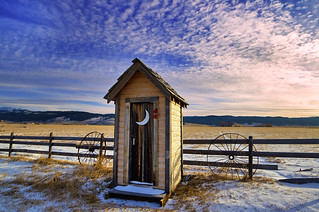
Really, the biggest problem for RV plumbing in cold weather is when there's water in the water lines. A bit of liquid in the holding tanks isn't generally a problem. So while you might not want to put water in your fresh tank and use your water pump, you can still use the toilet. But then there's that rather delicate issue – how on earth can you keep your RV bathroom from stinking to high heaven if you can't flush the toilet?
Ah, here's where winter alternative thinking comes in. While it's a bit more costly than using water, savvy winter RVers know they can flush their RV toilets – and keep things from icing up in the 'down under' area of the black water holding tank – by using RV antifreeze to flush with. Yes sir, use 'the pink stuff' to clear those unwanted leftovers from the toilet bowl.
Here's a hint to help keep down costs. You don't necessarily have to grab a gallon jug of antifreeze and just 'glug, glug, glug' dump a bunch down the hatch. If your unwanted wastes drop out of sight when you step on the toilet evacuation pedal, then all that remains is probably a light coating of liquid in the bowl. If you fill up a plastic spray bottle with antifreeze, just hold the bowl flapper open and spray a generous jet or two of antifreeze around the bowl to eliminate any unwanted leftovers. This will keep your expenses down, and unwanted odors, too.
Some RVers have suggested it might be less expensive to use cheap windshield washer fluid. There's a bit of controversy over that offer – some say it works great, while others have complained that when they used the stuff, it damaged their dump valves. The counter-argument is, "If it doesn't damaged the rubber in your windshield washer system, why would it damage the rubber seals in your dump valves?" Your wise RV sages can only say, "Duh, we don't know." But we do know that the cost of a gallon of RV antifreeze isn't that much more expensive than windshield washer fluid, so why chance it?
So grab your antifreeze and your road maps, winter roads are calling!
Wednesday, August 21, 2013
Sewer Solution provides alternative to dumping your tank
In a previous RV "incarnation," our home base located our RV downhill from the nearest sewer dumping port. Towing the rig up to the port was out of the question. What was the answer? Along came a system called "Sewer Solution," a system that allows you to pump out your RV holding tank using only a couple of garden hoses. And best of all for us, it sent that unwanted effluent uphill.
Here's a video that shows how Sewer Solution works.
Here's a video that shows how Sewer Solution works.
Monday, August 12, 2013
Holding tank odors invading? It may not be your black water system

When your RV plumbing system smells, the black water system often gets the finger pointing. But there are other suspects that may need an interview. Sometimes that horrific odor comes from the gray water system. A bit of detective work can help you track down the stinker.
The toilet system is pretty straight-forward. You have only a few things to check out. First, put water in the toilet bowl and let it stand. After a while, check it. The water level should not have changed in the toilet bowl. If it's gone down, then you've got a leaky bowl seal or sealing mechanism that needs attention.
Absent a leaky bowl seal, the next possibility is the floor flange gasket. These little rubber guys form an air-tight seal (in principle anyway) between the base of the toilet and the floor. If that gasket is compromised, either by age or by the toilet flange bolts not being tight enough, then air-to-air transfer can waft a nasty odor into your rig. First check flange bolt tightness: Your toilet should be tight to the floor, not "wiggly."
Before condemning the flange seal or gasket, make sure the gray water system isn't passing gas and pointing the finger at the toilet. Here's where your sniffer will be pressed into service. When you enter your RV and detect the stink, be brave: Shut the door behind you and carefully walk around sniffing. Your objective is to find the highest level of stink.
 |
| structuretech1.com |

If your RV is equipped with a washing machine (or is set up to accept one), you may find that where the machine drain hose attaches to the RV drain system that the P-trap you'd expect just isn't there. It's a weird world, but many RVers report that after they've had a washer professionally installed they've suffered stink issues, only to find the installers didn't put in a P-trap. We're not sure of the reasoning, but it's probably spelled P-R-O-F-I-T, but some outfits just don't put in a P-trap. And if the drain hose from the washer isn't then air-tight sealed to the gray water system, stink will follow.
Checked out the usual suspects and the stink remains? OK, pull the toilet up and replace the flange seal. If that still doesn't kill the odors, you may have a plumbing line in the rig that's not completely sealed. That's a tough one to track down, and may require a sensitive nose and persistence to track down.
Meantime, here's a few other ideas that can help: Use sink strainers, preferably wire mesh ones, to keep food particles from running down the drain. Try an enzyme or bacteria based holding tank treatment in the gray water system, and avoid bleach-containing dish detergents.
Tuesday, July 2, 2013
RV park owner mystified by inquiry letter, or so the story goes. . .

Even while most RVers have "all the comforts of home" with them in their rigs, including 'the biffy,' it's nice to know that the park of your choice is suitably equipped with all the amenities. This "letter" shows that sometimes, just asking about such things can lead to humorous misunderstandings.
An older lady, new to RVing, genteel of upbringing, was planning a vacation to Minnesota. In advance of their trip, she undertook to write to a prospective RV park to inquire about reservations. Concerned that the park have complete facilities available, she was at a bit of loss as to how exactly to write about – well – bathroom facilities. She couldn't bear to write such a vulgar word as, "toilet" in her letter, but finally, reached the conclusion the rather Victorian term, "bathroom commode," might suffice. But in writing those two big words, she found herself a bit aghast, it seemed so forward. Finally she settled on abbreviating the term.
One might only imagine the confusion that overtook the park manager, who on receipt of the letter, found his potential guest inquiring, "Does your RV park have its own BC?" Completely overthrown by the cryptic letters, the manager showed the letter to the rest of the staff and several guests, all of whom were equally mystified. Finally, like a lightening bolt, it hit him. "Does your RV park have its own Baptist Church?"
He quickly framed a response:
"Dear Madam:
"I very much regret the delay in answering your letter. But I do want you to know there is a BC about 20 miles distant north of the park. It's quite nice, and can seat 250 people at a time. While it is a bit of a drive, if you're in the habit of going regularly you'll be pleased to know that many take their lunches along and make a day of it. Folks who do this usually arrive early and stay late.
"You should know it is a beautiful facility and the acoustics are marvelous. Even normal delivery sounds are quite clearly heard. The last time my wife and I went was five years ago, and it was so crowded we had to stand the entire time. However, a fund raiser is planned to raise money for more seats; it will be held in the basement.
"I would like to add that it pains me not be able to go more regularly, but this is surely not for lack of desire. It just seems as the older we grow, it seems to take more of an effort, particularly in cold weather. However, if you decide to stay on in our park, perhaps I could go with you the first time you go, sit with you, and introduce you to others. Remember, ours is a friendly community."
Source: An old legend.
Monday, May 20, 2013
RV toilet sprayer alternatives.
 |
| Courtesy Camping World |
Some toilet models allow the addition of an after-market spray nozzle kit. Do you flush a Dometic? There's an after-market kit for that. It includes a spray nozzle, a clip to hang the nozzle on, and installation kit that includes a vacuum breaker. The purpose of the latter device is to prevent any liquids from the spray nozzle assembly from making their way backwards an back into the RV water supply system. Camping World will sell you one for a little over $60, but by being smart and shopping around, you can beat this price.
Keep in mind, in addition to the issue of these critters being a bit on the pricey side, some RVers have complained that because the thing is plumbed through the toilet supply line, there can be a bit of a loss off pressure, making your cleaning efforts a bit more difficult.
There are alternative approaches to this matter. Some RVers report (and we personally have experienced) that their shower head will reach out from the shower stall and down to the throne with ease. They just use the shower head to blast away at any undesirable bowl dwellers. OK, this is a really cheap solution, but unless you can hang onto the shower head while holding it over the bowl, then stretch and reach the shower control valves to turn on the pressure, you're apt to get a few drips on the floor. You pays your money . . .
Other alternatives? Sure enough. Put a plumbing T in the water line that serves your toilet. Incoming water flows into the T, then one side out to the toilet, and the other to a hose line leading to: 1) A shower head (with appropriate shut off valve) 2) A toilet bowl rinse head, or 3) a garden spray nozzle. The latter seemed like overkill to us, but hey, it does develop quite a stream.
But what about a vacuum breaker? If you're clumsy and apt to drop your new toilet bowl blaster in the pot and leave it there, yeah, you might want to add the vacuum breaker. Otherwise, it would seem pretty unlikely that icky stuff could make its way back into your fresh water system.
Tuesday, February 26, 2013
How about a recirculating RV toilet?

First, what's a recirculating toilet, and how does it work?
A recirculating toilet looks a lot like a common RV toilet, only it's not "moored" to the floor of the RV, being completely portable. Rather than dumping waste into a mounted holding tank, the system uses stored water and chemicals that dissolve the solid waste and then recirculate the wastes and water for multiple flushes. The wastes are contained in the toilet system, and when full, the unit is taken out of the RV and the contents dumped at an appropriate location.
You may have already experienced a recirculating toilet if you've taken a trip on a Greyhound bus or a flight on nearly any airline. Recirculating toilets are common on those conveyances.
So how about eliminating the worry about emptying holding tanks with the use of one of these "recirc" biffies? Several RVers who've used them report that while they do work, depending on your use level, these toilets have to be dumped every few days. So how often do you have to dump your RV black water holding tank? Will you be out in the boonies longer than your black water tank can wait for a dumping? True, it's easier to carry a recirc toilet out to the car or truck and drive it to a dump station than it is to hitch up a trailer, or maybe even break camp with a motorhome to head out to dump tanks.
But there are other considerations. First, the cost of a recirc toilet isn't something to take lightly. A popular recirculating toilet is manufactured by Thetford, the Electra Magic Model 80. Look to pay somewhere over $400 for the unit. The money layout doesn't stop there – you'll need to keep the thing "charged" with holding tank chemicals to kill the bacteria.
We've heard from RVers who've used recirc toilets, and the most common expression we hear are things like, "Yuck!" and "Stink." While the holding tank chemistry does supposedly kill the odor of the wastes, it tends to replace it with a lingering sort of fragrance that most people would prefer not to have hanging around their RV. Would you like to have your in-flight drinks served to you in the airplane bathroom?
If moving your RV away from your boondocking spot every couple of weeks to dump the holding tank isn't workable, consider a couple of alternatives: A "blue boy" portable waste tank to haul away the wastes, or a "porta potti" style portable toilet which uses fresh water and doesn't recirculate your waste products. The latter are a whole lot less expensive than recirc toilets, don't use near as much chemical, and from our own experience, smell a whole lot less offensive than visiting an airliner bathroom.
Monday, February 18, 2013
Stop that SeaLand seal leak

Often the problem is the rubber seal around the ball valve in the bottom of the bowl. Yes, you can cure the problem by taking the toilet apart and replacing the seal, but wait! You may be able to solve the problem with a less invasive procedure. At times a build up of minerals around the seal will no longer allow for a water (and stink) tight seal. A simple clearing away of those minerals may relieve you of the problem, and the hassle of a remove-and-replace job.
Here's what some creative RVers have done to clear up a seal problem.
Bowl cleaner trick: Some swear by pouring E-Z RV Bowl Cleaner (Valterra product V88229) in the bowl. Of course, if the bowl leaks excessively, it may take quite a few "pour it in, let it sit" cycles for you to make this one work.
Banish it with a brush: Get a small brush, like a toothbrush, and after opening the valve, do the "dental hyginist" trick around and around inside the seal. Minerals (and other not-so-foreign material) can sometimes get stuck in the seal. Obviously you'll want to reserve this toothbrush for the biffy, not your mouthy!
Shoot it! Nah, leave the gun in the gun safe, shoot it with silicone lube. DON'T use stuff that contains petroleum products, which includes the ever-popular Vaseline. Rubber and petroleum are pretty much incompatible in a sort of dog-eats-cat scenario. Yes, it might work for a while, and then your rubber seal may vamoose permanently.
Thursday, November 15, 2012
RV Holding Tank Dump 1-2-3
By the RV Geeks
Dumping your RV's black and grey tanks might seem like a no-brainer, but we can't tell you how many times we've seen people who could use a little help with the basics.
Be sure to watch the video below.
Properly dumping your RV's holding tanks requires a few simple procedures to help keep things odor-free and running smoothly. For everyday tank dumping, this video is the "express version" of our original "How To Dump & Clean an RV Black Tank." If your black tank really needs a super cleaning, you can watch the original, more detailed video here:
If you're not having tank odor problems and just want a quick overview of basic tank dumping procedures, this new video gets right to the point. Many RVers seem to think their black tank is clean when they just empty it and flush out the sewer hose with water from the grey tank. Even those RVers who use a black tank flush system often don't utilize the most important piece of equipment necessary for monitoring the cleanliness of the tank: a clear sewer elbow.
But using a clear sewer elbow on your camper isn't enough. As we demonstrate, even a black tank flush connection still won't do the job unless used correctly. We'll show you how to be sure your black tank is really empty, keeping it clean and odor-free and making your motorhome, travel trailer or fifth wheel a nicer place to be.
RV Geeks offers basic DIY (do it yourself) RV service, repair, maintenance and travel tips from full-time RVers who have been handling most of their own maintenance since hitting the road in 2003. Be sure to confirm that all methods and materials used are compatible with your particular recreational vehicle. Every type of motorhome, motorcoach, fifth wheel, travel trailer, bus conversion, camper and toy hauler is different, so your systems may not be the same as ours. RVgeeks is proud to be affiliated with RVtravel.com.
While we're not RV technicians, we're very mechanically inclined and have learned a lot about RV systems over the years. We handle most of our own minor service, maintenance and repair work on our 2005 43' Newmar Mountain Aire diesel pusher. We also maintained our 2002 39' Fleetwood Bounder Diesel during our first two years on the road.
We meet lots of newer RVers who are eager to learn some basics about maintaining and caring for their rigs. After more than 9 years on the road, we want to share what we've learned (some of it the hard way). We hope our experiences can help other RVers go DIY, saving some time, money and effort, while experiencing the satisfaction of a job well done. We do not pretend to be experts on any particular RV topic, and mostly know about maintaining our own rig. But lots of things are the same on RVs in general, and diesel pushers in particular. Comments welcome!
Dumping your RV's black and grey tanks might seem like a no-brainer, but we can't tell you how many times we've seen people who could use a little help with the basics.
Be sure to watch the video below.
Properly dumping your RV's holding tanks requires a few simple procedures to help keep things odor-free and running smoothly. For everyday tank dumping, this video is the "express version" of our original "How To Dump & Clean an RV Black Tank." If your black tank really needs a super cleaning, you can watch the original, more detailed video here:
If you're not having tank odor problems and just want a quick overview of basic tank dumping procedures, this new video gets right to the point. Many RVers seem to think their black tank is clean when they just empty it and flush out the sewer hose with water from the grey tank. Even those RVers who use a black tank flush system often don't utilize the most important piece of equipment necessary for monitoring the cleanliness of the tank: a clear sewer elbow.
But using a clear sewer elbow on your camper isn't enough. As we demonstrate, even a black tank flush connection still won't do the job unless used correctly. We'll show you how to be sure your black tank is really empty, keeping it clean and odor-free and making your motorhome, travel trailer or fifth wheel a nicer place to be.
RV Geeks offers basic DIY (do it yourself) RV service, repair, maintenance and travel tips from full-time RVers who have been handling most of their own maintenance since hitting the road in 2003. Be sure to confirm that all methods and materials used are compatible with your particular recreational vehicle. Every type of motorhome, motorcoach, fifth wheel, travel trailer, bus conversion, camper and toy hauler is different, so your systems may not be the same as ours. RVgeeks is proud to be affiliated with RVtravel.com.
While we're not RV technicians, we're very mechanically inclined and have learned a lot about RV systems over the years. We handle most of our own minor service, maintenance and repair work on our 2005 43' Newmar Mountain Aire diesel pusher. We also maintained our 2002 39' Fleetwood Bounder Diesel during our first two years on the road.
We meet lots of newer RVers who are eager to learn some basics about maintaining and caring for their rigs. After more than 9 years on the road, we want to share what we've learned (some of it the hard way). We hope our experiences can help other RVers go DIY, saving some time, money and effort, while experiencing the satisfaction of a job well done. We do not pretend to be experts on any particular RV topic, and mostly know about maintaining our own rig. But lots of things are the same on RVs in general, and diesel pushers in particular. Comments welcome!
Thursday, November 8, 2012
RVer is impressed with portable waterless toilet
We recently wrote about a new water-less toilet called the Dry Flush. Most readers who commented on the article were not impressed. But one reader was, John Farr, who sent us this email:
 Our travel is with a Casita travel trailer and has been limited by seasonal conditions. We bought the littlest and the lightest travel trailer we could find so we could camp out of the weather and have inside plumbing. It works wonderfully well in the right season. But high fuel costs hauling sludge around did not make sense and having it freeze up was worse.
So the idea of a functional Dry Flush had great appeal. I have used plastic bags, etc. but they were not easy to handle or dispose of. I read your article about the Dry Flush, then looked at their material and called the company. They made sense and have the financial backing to survive. So we ordered one and it arrived this week.
It looks good, it is solidly built, and one old man can pick it up and move it. So I set it in my bathroom (at our age we each have a bedroom and bathroom) and proceeded to start to use it. I will need to finish an entire cycle of a bag and remove it to tell you the entire story. Here is the first report:
After three days, there is no odor, and it is much easier to clean than a regular toilet. The unit has so many 'flushes" per series of bags so you do not flush it with each use. It is informative (polite discussion) to see just how much passes thru your system in a set period of hours. I am a big guy and have had a small bladder my entire life. So realizing how often I pee and the quantity has been interesting.
The unit is standard toilet high, 14 inches, which is a big improvement over the usual 10 to 12 inches in most RVs. Since the entire bowl inside has a Mylar fabric-type covering it is bigger than most RV toilets and you do not have to clean it! Bingo!
It comes with L brackets to fasten it to an RV. I do not think you would want it rolling around. However you can set it anywhere you wish -- the porch, guest room, etc. It runs off of electricity and has a rechargeable battery that runs off of 110 power or a RV electrical system.
For a cabin or even a second home, this would be tremendous and much easier than have to weatherize, buy into a sewer system or build a leach field.
As I finish this first bag I know what to study and see how Dry Flush really operates. My first impression is that this will be one of the hot new items of 2013 and it is a creative idea and well built unit to handle the job it was designed to do.
 Our travel is with a Casita travel trailer and has been limited by seasonal conditions. We bought the littlest and the lightest travel trailer we could find so we could camp out of the weather and have inside plumbing. It works wonderfully well in the right season. But high fuel costs hauling sludge around did not make sense and having it freeze up was worse.
So the idea of a functional Dry Flush had great appeal. I have used plastic bags, etc. but they were not easy to handle or dispose of. I read your article about the Dry Flush, then looked at their material and called the company. They made sense and have the financial backing to survive. So we ordered one and it arrived this week.
It looks good, it is solidly built, and one old man can pick it up and move it. So I set it in my bathroom (at our age we each have a bedroom and bathroom) and proceeded to start to use it. I will need to finish an entire cycle of a bag and remove it to tell you the entire story. Here is the first report:
After three days, there is no odor, and it is much easier to clean than a regular toilet. The unit has so many 'flushes" per series of bags so you do not flush it with each use. It is informative (polite discussion) to see just how much passes thru your system in a set period of hours. I am a big guy and have had a small bladder my entire life. So realizing how often I pee and the quantity has been interesting.
The unit is standard toilet high, 14 inches, which is a big improvement over the usual 10 to 12 inches in most RVs. Since the entire bowl inside has a Mylar fabric-type covering it is bigger than most RV toilets and you do not have to clean it! Bingo!
It comes with L brackets to fasten it to an RV. I do not think you would want it rolling around. However you can set it anywhere you wish -- the porch, guest room, etc. It runs off of electricity and has a rechargeable battery that runs off of 110 power or a RV electrical system.
For a cabin or even a second home, this would be tremendous and much easier than have to weatherize, buy into a sewer system or build a leach field.
As I finish this first bag I know what to study and see how Dry Flush really operates. My first impression is that this will be one of the hot new items of 2013 and it is a creative idea and well built unit to handle the job it was designed to do.
Subscribe to:
Posts (Atom)